
How Things Break
When our model fails to solve the problem because it no longer reflects the real world, the model breaks down.

We know how things break in the material world: a critical component fails, and the device no longer functions.
We know how to fix things in the material world: first, diagnose the cause of the breakdown, identify the failed part and replace it.
Fixing broken systems is similar, but systems are more like ecosystems than machines. A machine (or programmed digital device) is a closed system with clearly defined inputs, processes and outputs: add fuel (the input), the engine/motor turns this input into mechanical force (the process) and the vehicle accelerates (the output).
In all cases, how we solve problems / fix what’s broken is based on a cognitive / cultural model of how the world works. Whatever model is accepted in our cultural milieu is assumed to be “natural order of things”--especially if is cloaked in the finery of a higher authority.
When our model fails to solve the problem because it no longer reflects the real world, the model breaks down. Models of how the world works are scale-invariant: we each have an internal cultural-cognitive model of processes, problems and solutions that we use to make sense of our own internal life, our relationships, groups, enterprises, institutions, economies and governments.
When the model breaks down, the individual, relationship, group, enterprise, institution or government breaks down because what’s broken can no longer be fixed, and that failure undermines the real-world systems we depend on.
Let’s trace how the modern model of how the world works reached its current configuration, starting with the advent of the scientific method and the Industrial Revolution powered by hydrocarbons, up through the way that digital technologies have changed our response to things failing.
The Industrial Revolution enabled by the scientific method of data collection and experimentation vaulted a mechanistic model of how the world works to the forefront of modern life.
The natural world came to be viewed as a machine much like a clock: once we identify the parts and mechanisms--the laws of Nature--then we can optimize the outputs we seek--higher crop yields, controllable nuclear fission, higher productivity, etc.--by optimizing the processes of the machine.
A mechanism is a closed system: everything we need to understand how it works is in the mechanism itself.
In this model, systems are like machines: everything in the system can be broken into its constituent parts and laws of nature processes.
But this reductionist, mechanistic approach fails when applied to open, complex, self-organizing natural systems such as ecosystems which are:
1. Open--influenced by external factors that are inherently unpredictable.
2. Complex--evolving as countless participants interact in novel ways.
3. Self-organizing: these interactions are not linear like machinery or software, their structures are adaptive and organize themselves via interactions rather than hierarchies, interactions which are emergent, meaning the interactions generate novel behaviors and structures beyond what is predictable from the initial conditions, i.e. the attributes of each participant.
Human societies share these traits with ecosystems, but have additional dynamics. Plants and animals cooperate and compete in ways that have been selected over thousands of generations. Many human behaviors are also hard-wired by genetics and epigenetics, but we also have rational, intuitive minds that can mull situations and make conscious decisions.
Like other life forms, we cooperate and compete within our own species and in the wider world, we make sacrifices for the next generation and act in our own self-interest. Humans are social beings, as our survival depends on the cooperative efforts of groups. Humans are not solitary animals, as our adaptive strengths are social in nature.
As a result, we have shared interests and private interests. Our interests overlap with others, but also compete with others’ private interests. This dynamic of both cooperation and competition serving our interests is the core dynamic of human social orders.
What makes human societies unique is our ability to encode beneficial knowledge and behaviors in language and social organizations that preserve and pass this knowledge on to future generations. This social knowledge is highly adaptive, enabling rapid advancements that leapfrog the far slower adaptive mechanisms of epigenetics and the selection of random genetic mutations.
These social organizations take many forms: family groups, tribal memberships, governments, religions, regional trade networks, cultural ties, mutual-aid groups, for-profit enterprises, and so on.
These organizations aggregate resources which typically leads to hierarchies of authority, leadership and control: a tribal or religious leader is selected, an entrepreneur becomes the head of an enterprise, authorities must be obeyed to serve the common good, etc.
Concentrating resources and authority in organizations and human dependence on language to communicate and encode knowledge enable two competing forces:
1) rapid advancement as resources and knowledge can be organized on a large scale
2) deception, guile and artifice can be used to transfer resources from common interests to private interests. This process exploits language and social organization to persuade the many to agree to arrangements that are deceptively presented as benefiting everyone but that actually benefit the few managing the persuasion/deception.
This is the foundation of our capacity to enrich the few at the expense of the many not by force but by persuading the many to accept a model of how the world works that distributes power and wealth to the few.
The basic mechanism is to persuade others to accept a model as being “the way it is” rather than what it really is, which is an arbitrary arrangement that claims to be the “natural order of things” while distributing resources asymmetrically, far in excess of what is fair or necessary.
For example, if a populace accepts that the “divine right of kings” monarchy is the “natural order of things,” the monarchy can concentrate resources to the point that the majority are impoverished and shared interests receive few resources.
As social beings, humans have an innate sense of fairness and are alert to free-riders--those who take a full share of the work of others but contribute little or nothing--and those who use the authority granted to them to serve shared interests to serve their own interests.
The core dynamic of social orders is the constant tension and rebalancing between those using social organization to serve their own interests at the expense of shared interests, and those seeking to limit the resources distributed to the few so more resources can be devoted to serve common interests.
Things break when:
1. The resources siphoned off to enrich the few reach extremes that no longer serve shared / common interests, and the result is social disorder leading to the overthrow of the regime’s model, authority and leadership.
2. The model used by the ruling elite to justify their self-enrichment no longer reflects the real world it claims to model. As this disconnect widens, the problems created by the fact that the world isn’t operating as the model claims undermine and eventually break the status quo regime and model.
For example, the model that private industry benefits us all broke down when the industrial waste being dumped in the shared commons of the air and waterways began poisoning the public.
3. The signals that authority and institutions send that the model is working no longer reflect the real world. Signals can be understood as representing, symbolizing and reinforcing the legitimacy of the regime’s ruling elite and the institutions they control.
For example, a university diploma--the institutionalized verification of four years of study--reinforces the university’s legal authority and cultural-economic-social standing. The diploma signals to employers that the graduate has gained the knowledge needed to become a productive, valuable worker. For the graduate, the diploma offers entree to institutions that would otherwise be inaccessible.
This signal no longer reflects the real world, as university graduates may have learned very little of productive economic value, and the scarcity value of college diplomas has declined as half of the workforce has a diploma or college experience. The model that claims university diplomas grant the recipient substantial lifelong financial value is no longer universal, and as AI disrupts the cognitive work that was reserved for college graduates, the model is breaking down.
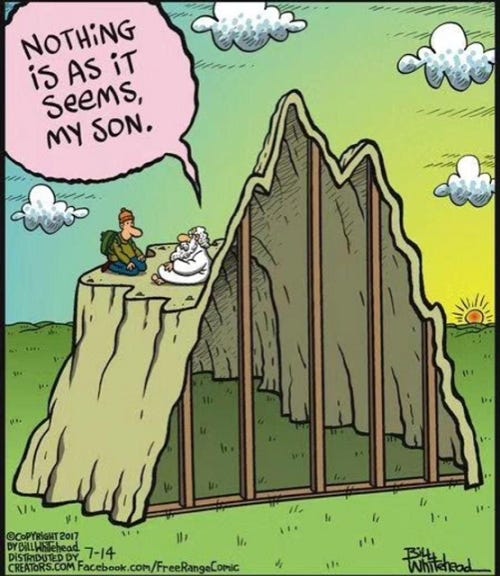
4. As the model no longer maps the real world and things start breaking down, those benefiting from the status quo model substitute artificial simulations of adaptation for authentic adaptation: they proclaim that the model still works just fine and that they’re fixing what’s broken in the real world, but all they’re doing is constructing a screen to mimic “fixing what’s broken” that keeps the system that benefits them as-is, as keeping the status quo unchanged serves their own interests.
Using artifice as the “solution” in the digital era is low-cost and effective in the short-term, as virtue-signaling, grandiose pronouncements and even currency can all be created out of thin air and distributed on a mass scale.
Using artifice as the “solution” keeps their source of wealth and power intact, and masks the pain generated as things break down. Those experiencing the pain are persuaded that the problems are being solved and what’s broken is being fixed, but the real world hasn’t been fixed; it’s just been cloaked with the Emperor’s New Clothing: artificial facsimiles of fixing what’s broken rather than actually fixing what’s broken because changing the real world is costly and difficult and therefore painful, and so the easy choice is the painless “solution” of artifice.
The problem with using artifice as the “solution” is it’s self-liquidating: its initial effectiveness reinforces the delusion that “fake it until we make it” will actually fix what’s broken, when all it’s really doing to squandering time and resources while the real-world problems metastasize and the dominoes start falling throughout the system.
The core mechanism of artifice is to create a synthetic version of what was authentic by signaling that the model is still working and so all is well.
Statistics no longer reflect the real world economy, they are synthetic signals that all is well. New programs are announced with great fanfare that don’t actually fix what’s broken, but they signal that the authorities are actively “solving problems.”
These dynamics explain the dominance of theatrics and finance, as both are digital and easy to generate, unlike the real world. Our media and culture are awash in manic theatrics and obsessed with getting rich / finance.
Those reaping the rewards of substituting artificial “fixes” for authentic fixes are in effect stifling adaptation, for their efforts are not devoted to actually fixing what’s broken in the real world or re-aligning the model (Waste Is Growth, “money” fixes everything) with the real world; they’re devoted to issuing theatrical, financial signals that the model that’s enriching them is working just fine when in fact it no longer makes sense of the real world, for it no longer maps the real world. It is a free-floating fantasy of artifice doomed to self-liquidation.
Adapt or die, and in choosing artifice over authenticity, they’re choosing a disorderly demise of the status quo model. When the model breaks, everything that looked to the model for guidance breaks.
This is how things break: “fixing what’s broken” with fake “solutions” serves the self-interest of those at the top, as the pain of things breaking is distributed to others while the gains continue flowing to them.
As things unravel, they’re frantically increasing faux theatrical-financial “fixes” that accelerate the doom-loop of self-liquidation. And since that has worked for many years, that’s all they know how to do.
CHS NOTE: I understand some readers object to paywalled posts, so please note that my weekday posts are free and I reserve my weekend Musings Report for subscribers. Hopefully this mix makes sense in light of 1) writing is my only paid work/job, and 2) something here may well change your life in some highly useful way. I am grateful for your readership and blessed by your financial support.
